Look for the dates, how many units of electricity you used, the price per unit and the daily standing charge. Work out what you were charged for those dates first. Then check the amount due, which can include earlier charges and payments.
EnergyFigures editorial team · Published · Reviewed
Electricity bill calculator
Read the statement dates and find your actual charges
Start with the bill period and the service address. If you have moved in or out, compare the start or end date with your own record. A statement date shows when the supplier produced the bill. The dates beside the meter readings and charges tell you which supply period you are paying for. A balance brought forward can include an earlier bill.
Find the electricity section if you get a combined gas and electricity statement. Write down the kWh, the price per kWh and each daily standing charge. Note any payments, discounts, adjustments and VAT as separate entries. Some bills show rates with VAT included and some give subtotals plus a separate VAT line. Only add VAT if the rates you’re using are shown before VAT.
- If you think you’ve been charged too much for your energy - Citizens Advice
Citizens Advice. Checking unexpectedly high charges, estimates and meter details. Accessed 25 November 2026. - Energy price cap unit rates and standing charges | Ofgem
Ofgem. Applicable period, regional tables, meter type and payment method. Accessed 25 November 2026.
Check the meter readings
Look at which reading begins the billed period, which closes it and how the supplier obtained them. Bill abbreviations differ, so use the key on that statement. Check if the supplier used a reading from your meter, one you sent in or an estimate. If you have a photo or a record of the reading on the same date, compare the figures and the meter serial number. In a block of flats, be especially careful to identify the right meter before reporting a reading.
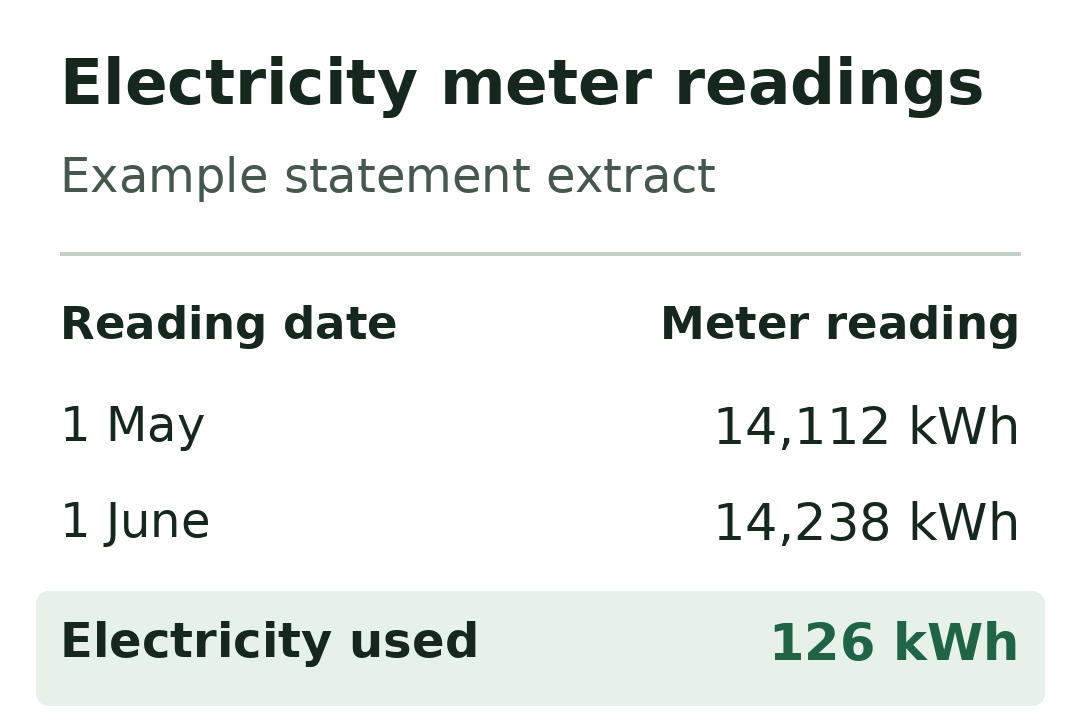
With one register and no meter change, subtract the earlier reading from the later one. For example, 14,238 minus 14,112 is 126 kWh. A meter exchange may give you two sets of readings, one ending on the old meter and one starting on the new one. Check each set against its serial number and add the usage across both meters.
If a reading moves backwards or looks completely different, keep the original records and ask the supplier what happened. If your meter was replaced, or if you have solar equipment or a separate export display, check that you are looking at the register for imported electricity.
- How to read your gas or electricity meter - Citizens Advice
Citizens Advice. Taking readings and telling actual and estimated readings apart. Accessed 25 November 2026. - If you think you’ve been charged too much for your energy - Citizens Advice
Citizens Advice. Checking unexpectedly high charges, estimates and meter details. Accessed 25 November 2026.
Check the arithmetic on a simple bill
For a 30-day example with 120 kWh priced at 25p and a daily charge of 50p, the usage costs £30 and the standing charge £15. The period’s new electricity charge is £45 if those rates already include the applicable VAT. An existing £12 credit would reduce the resulting balance to £33 if there were no other movements. If you paid £35 after the bill period, whether it appears depends on the supplier’s statement cut-off.
If you used no electricity while away for seven days, those seven days can still attract a standing charge under a tariff with a daily fee. The supplier counts days of supply. If the bill splits the charges across two prices, check that no days or units have been counted twice.
- Energy price cap unit rates and standing charges | Ofgem
Ofgem. Applicable period, regional tables, meter type and payment method. Accessed 25 November 2026.
Check rate changes and Economy 7 separately
A price change mid-bill can produce separate lines. Suppose the meter shows 100 kWh before a change and 40 kWh afterwards. At 25p and 30p per kWh respectively, the energy alone is £37. The standing charge calculation still uses the number of days at each applicable daily price. If your record has no reading at the price change, ask how the supplier allocated the split if you cannot reproduce it.
On a two-rate tariff, keep both registers and their prices separate. In an invented example, 80 kWh at 31p costs £24.80 and 60 kWh at 15p costs £9. Add the two for £33.80 before any standing charge. The two registers may appear as Rate 1 and Rate 2, so check the supplier’s labels before assuming which is the cheaper one.
- Energy price cap unit rates and standing charges | Ofgem
Ofgem. Applicable period, regional tables, meter type and payment method. Accessed 25 November 2026. - How to read your gas or electricity meter - Citizens Advice
Citizens Advice. Taking readings and telling actual and estimated readings apart. Accessed 25 November 2026.
Work out what to query
If the maths adds up but something still looks wrong, tell your supplier which line you’re querying. Give them the rate, reading, address or dates they need to check. Send the dated reading through your supplier’s official account or meter-reading channel. Keep a copy of the old bill, the new reading and any reply. Ask for a corrected statement or a written explanation of how the supplier used the figures.
If you used more electricity than you expected, check how many days each bill covers, whether more people were home, whether you used electric heating and whether either bill was estimated. A correction after a string of estimates can move usage into the bill that finally uses a reading. Compare bills again after confirming the actual dates and units.
- If you think you’ve been charged too much for your energy - Citizens Advice
Citizens Advice. Checking unexpectedly high charges, estimates and meter details. Accessed 25 November 2026. - How to read your gas or electricity meter - Citizens Advice
Citizens Advice. Taking readings and telling actual and estimated readings apart. Accessed 25 November 2026.
Sources and further reading
- How to read your gas or electricity meter - Citizens Advice
Citizens Advice. Actual and estimated meter readings. Accessed 25 November 2026. - Energy price cap unit rates and standing charges | Ofgem
Ofgem. Current and upcoming rates, payment basis and postcode lookup. Accessed 25 November 2026. - If you think you’ve been charged too much for your energy - Citizens Advice
Citizens Advice. Checking unexpectedly high charges and meter registration. Accessed 25 November 2026. - If you think you’ve been charged too much for your energy - Citizens Advice
Citizens Advice. Checking unexpectedly high charges, estimates and meter details. Accessed 25 November 2026. - Energy price cap unit rates and standing charges | Ofgem
Ofgem. Applicable period, regional tables, meter type and payment method. Accessed 25 November 2026. - How to read your gas or electricity meter - Citizens Advice
Citizens Advice. Taking readings and telling actual and estimated readings apart. Accessed 25 November 2026.
Related resources
- How to understand a dual-fuel energy bill
Read the electricity and gas sections of a dual-fuel bill, reconcile standing charges and follow credits and payments through the account.
- How to check whether your energy bill is correct
Check your energy bill against meter readings, rate dates, payment history and both fuel calculations before asking for a correction.
- How to read a traditional electricity meter
Read whole digits, two-rate rows and mechanical electricity dials, including the tricky pointer between nine and zero.
- Electricity bill calculator
Work out your electricity bill from metered usage, the unit price and standing charge for your exact billing dates.
- Energy bill calculator
Estimate your combined gas and electricity bill using your meter usage, unit rates, standing charges and exact billing dates.
- How to reduce your energy bills in the UK
Check your tariff and use your meter to find the changes that could make the biggest difference to your UK household energy bills.
- How the Ofgem energy price cap works
See which tariffs Ofgem’s energy price cap covers and understand unit rates, standing charges and the national headline figure.
- What the latest energy price cap means for households
Find the current and next announced energy cap periods and see how a rate change could affect the household bill you actually pay.
- Why your energy bill is higher than the price cap
Find out why a household can pay more than the headline price cap and what to check if its tariff charges look wrong.