Check the gas and electricity sections separately, even if you pay for both with one Direct Debit. Add what both fuels cost for the dates on the bill, then check how your supplier applied your payments and any credit.
EnergyFigures editorial team · Published · Reviewed
Energy bill calculator
Find the separate parts for gas and electricity
A dual-fuel statement lets you see both supplies on one account. Start with the gas pages and electricity pages before looking at the amount due. Each fuel will have its own meter readings, number of units, unit price and daily standing charge. Find the dates for each fuel. If one switched supplier or one meter was replaced mid-month, the periods can be different.
Write the details down in two columns, one for gas and one for electricity. Check the property address on the statement and the meter serial number for each fuel. If the supplier shows a reading as estimated, see whether you have an actual reading for around that time. Send it to the supplier through your account and ask how it affects the bill if the difference is large.
Keep the gas meter readings and gas kWh in separate boxes. You can subtract electricity meter readings in kWh if you have the same meter and register throughout. A gas meter measures volume. The bill shows the result after conversion so you can multiply the billed kWh by the price per kWh.
- Energy price cap unit rates and standing charges | Ofgem
Ofgem. Applicable period, regional tables, meter type and payment method. Accessed 25 November 2026. - How to read your gas or electricity meter - Citizens Advice
Citizens Advice. Taking readings and telling actual and estimated readings apart. Accessed 25 November 2026. - Gas meter readings and bill calculation - GOV.UK
GOV.UK. How delivered gas volume becomes billed kWh. Accessed 25 November 2026.
Check the two standing charges and the unit prices
On a tariff with separate daily charges, you can pay one standing charge for electricity and another for gas, even when you get one bill. Multiply each daily charge by the number of days for that fuel. If a statement covers a rate change, split out the days on each price before adding both sets of daily charges. On a two-rate electricity tariff, check the cost of both blocks of usage and count the electricity standing charge once for each day of supply.
Look at how the rates are shown for each fuel. If one subtotal is before VAT and the other is after VAT, get both to the same stage before adding them. Use the supplier’s own breakdown and any applicable VAT rates for the bill dates. The energy bill calculator lets you enter each fuel separately and compare what you work out with what you were charged.
- Energy price cap unit rates and standing charges | Ofgem
Ofgem. Applicable period, regional tables, meter type and payment method. Accessed 25 November 2026.
Follow a worked example through to the account balance
Say your statement covers 30 electricity days and 28 gas days after a move. You used 180 kWh of electricity at 26p, with a 50p daily charge. That’s £46.80 for the units and £15 for the days, making £61.80. You used 450 kWh of gas at 7p, with a 30p daily charge. That’s £31.50 for the units and £8.40 for the days, making £39.90. The combined new charges are £101.70. These prices are made up and include any VAT that applies in the example.
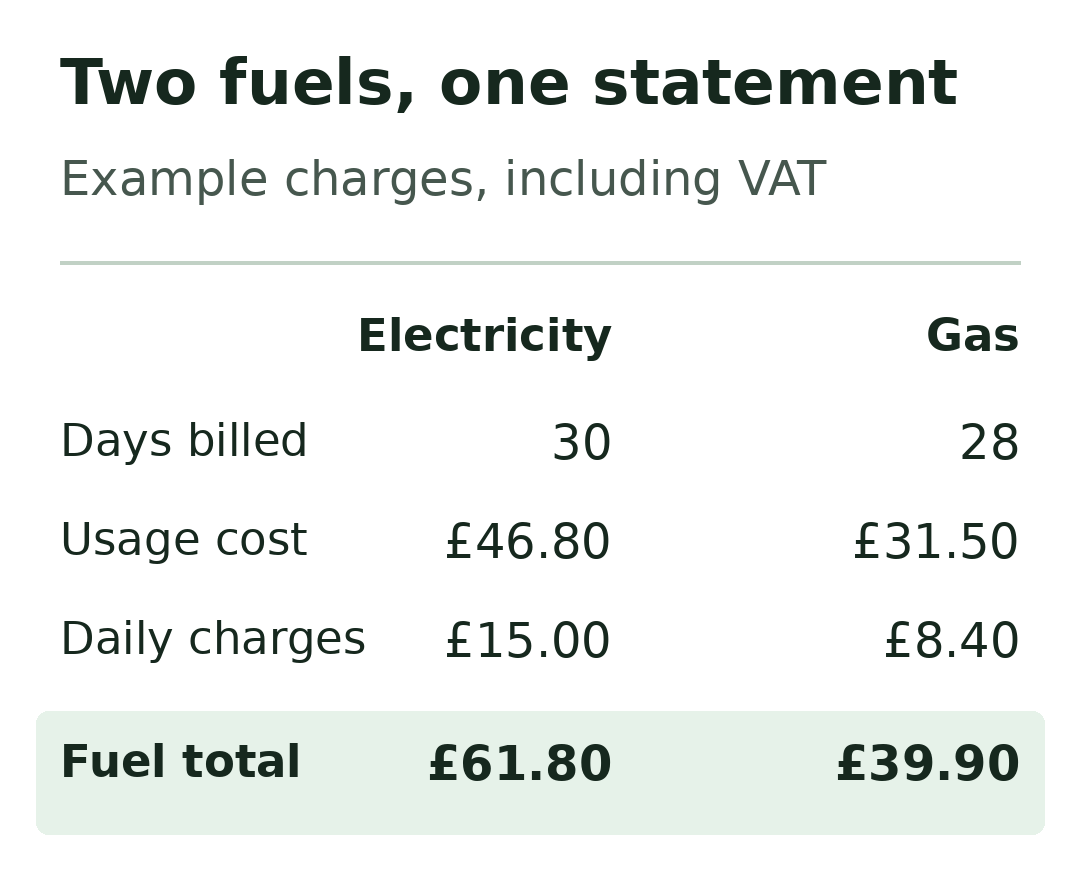
Suppose you also had £20 in credit at the start of the statement and paid £70 before it closed. Subtract both amounts from £101.70 and the balance is £11.70 owed, assuming no other adjustments. If the supplier took £70 after the statement closed, you may need to look at your current account to see it. If it has already refunded you the £20, look for a matching payment out of the account rather than counting the same credit twice.
- Energy price cap unit rates and standing charges | Ofgem
Ofgem. Applicable period, regional tables, meter type and payment method. Accessed 25 November 2026. - If you think you’ve been charged too much for your energy - Citizens Advice
Citizens Advice. Checking unexpectedly high charges, estimates and meter details. Accessed 25 November 2026.
If one fuel looks wrong
If only one fuel went up, ask the supplier about that charge first. Give the meter reading, bill dates and the line you’re querying. If the issue is a payment, check the bank date and how the supplier applied it. If you share the bill, agree which dates and which part of the charges you’re sharing. A balance owed before you moved in needs to be dealt with separately from energy used since the move.
When you’ve recently switched one fuel, keep the previous supplier’s final bill beside the new one. Check where the old daily charges stop and the new ones start. If you’re comparing dual fuel with two separate suppliers, use the same gas and electricity kWh and the same dates on both sides. Include each standing charge and any exit fees or discounts that apply. Use the combined balance only to check what you owe your current supplier.
- If you think you’ve been charged too much for your energy - Citizens Advice
Citizens Advice. Checking unexpectedly high charges, estimates and meter details. Accessed 25 November 2026. - If your energy supplier has increased your direct debit payments - Citizens Advice
Citizens Advice. How estimated annual use and account balances affect payments. Accessed 25 November 2026.
Sources and further reading
- Energy price cap unit rates and standing charges | Ofgem
Ofgem. Current and upcoming rates, payment basis and postcode lookup. Accessed 25 November 2026. - How to read your gas or electricity meter - Citizens Advice
Citizens Advice. Actual and estimated meter readings. Accessed 25 November 2026. - Gas meter readings and bill calculation - GOV.UK
GOV.UK. Gas volumes and billed kWh. Accessed 25 November 2026. - If your energy supplier has increased your direct debit payments - Citizens Advice
Citizens Advice. How suppliers calculate payments and what to ask for. Accessed 25 November 2026. - Energy price cap unit rates and standing charges | Ofgem
Ofgem. Applicable period, regional tables, meter type and payment method. Accessed 25 November 2026. - How to read your gas or electricity meter - Citizens Advice
Citizens Advice. Taking readings and telling actual and estimated readings apart. Accessed 25 November 2026. - Gas meter readings and bill calculation - GOV.UK
GOV.UK. How delivered gas volume becomes billed kWh. Accessed 25 November 2026. - If you think you’ve been charged too much for your energy - Citizens Advice
Citizens Advice. Checking unexpectedly high charges, estimates and meter details. Accessed 25 November 2026. - If your energy supplier has increased your direct debit payments - Citizens Advice
Citizens Advice. How estimated annual use and account balances affect payments. Accessed 25 November 2026.
Related resources
- How to read your electricity bill
Find the units, dates, meter readings and charges on a domestic electricity bill and distinguish them from your payments.
- How to read your gas bill
Understand gas bill readings, the conversion from meter volume to kWh and how the supplier charges for standing days.
- How to compare dual-fuel and separate energy tariffs
Compare a combined gas and electricity deal with separate suppliers, including both standing charges and discounts.
- How to calculate an appropriate energy Direct Debit
Estimate an energy Direct Debit from your annual kWh, forecast tariff costs and existing balance.
- Energy bill calculator
Estimate your combined gas and electricity bill using your meter usage, unit rates, standing charges and exact billing dates.
- Energy bill credit and debit balance calculator
Project your energy account balance month by month using payments, tariff costs and different winter and summer consumption.
- Energy bill split calculator
Split an energy bill between housemates equally or by agreed weights, with shares that add up to the penny.
- How to reduce your energy bills in the UK
Check your tariff and use your meter to find the changes that could make the biggest difference to your UK household energy bills.
- How the Ofgem energy price cap works
See which tariffs Ofgem’s energy price cap covers and understand unit rates, standing charges and the national headline figure.