You can pay more than the headline figure even if your rates follow the cap. Start by checking the unit price and standing charge for your tariff. Then look at how much energy you used and whether the bill includes an earlier balance.
EnergyFigures editorial team · Published · Reviewed
Energy bill calculator
Find the charge you want to check
Start with the part of the bill that looks too high. Find the unit price in pence per kWh, the daily standing charge, the billing dates and the supply address. Ofgem’s headline is an annual figure for typical use in Great Britain. The cap limits what suppliers can charge on eligible default tariffs. A home using more units can pay more over the year, even if every rate on its bill is correct.
A bill with two fuels should give you separate gas and electricity charges. Copy both rates and both daily charges. For electricity, note whether there’s a single rate or separate day and night prices. Then check the tariff and payment method. Ofgem has separate cap tables for Direct Debit, standard credit and prepayment, and the region and dates must match. A fixed deal follows the prices in its own terms.
- Energy price cap and standing charges explained | Ofgem
Ofgem. Coverage, calculation and the benchmark annual bill. Accessed 25 November 2026. - Energy price cap unit rates and standing charges | Ofgem
Ofgem. Applicable period, regional tables, meter type and payment method. Accessed 25 November 2026. - If you think you’ve been charged too much for your energy - Citizens Advice
Citizens Advice. Checking unexpectedly high charges, estimates and meter details. Accessed 25 November 2026.
Put the extra units into pounds
Say two homes are on the same hypothetical electricity tariff at 25p per kWh. One uses 1,000 kWh more over the year. At that rate the extra electricity costs £250. If both homes are supplied for the same number of days, their daily standing charges are the same. A larger total can come entirely from extra units, so check the rate and the kWh as two separate steps.
On a two-rate tariff, check one register at a time. Work out the units billed at each price and then add both charges to the standing charge. Use the cap table that applies to multi-rate electricity. The day price alone can be higher than a single-rate figure, so looking at those two numbers in isolation tells you very little about the whole bill.
If the dates cross a tariff change, work through each set of prices on its own. Compare the day count and the price per day, then check whether the units are based on readings or an estimate. Include VAT only where it applies and only once. Use the dated rate tables and their VAT notes before comparing what you calculated with the statement.
- Energy price cap unit rates and standing charges | Ofgem
Ofgem. Applicable period, regional tables, meter type and payment method. Accessed 25 November 2026.
Read what you owe separately from what you used
You might see “balance brought forward”, “new charges”, “payments received” and “amount due” on the same page. For example, if the new charges are £120, you already owed £50 and you paid £80 before the statement was issued, the resulting balance is £90. The new energy still cost £120. If that £80 left your bank after the statement date, check the next statement before asking for it to be added again.
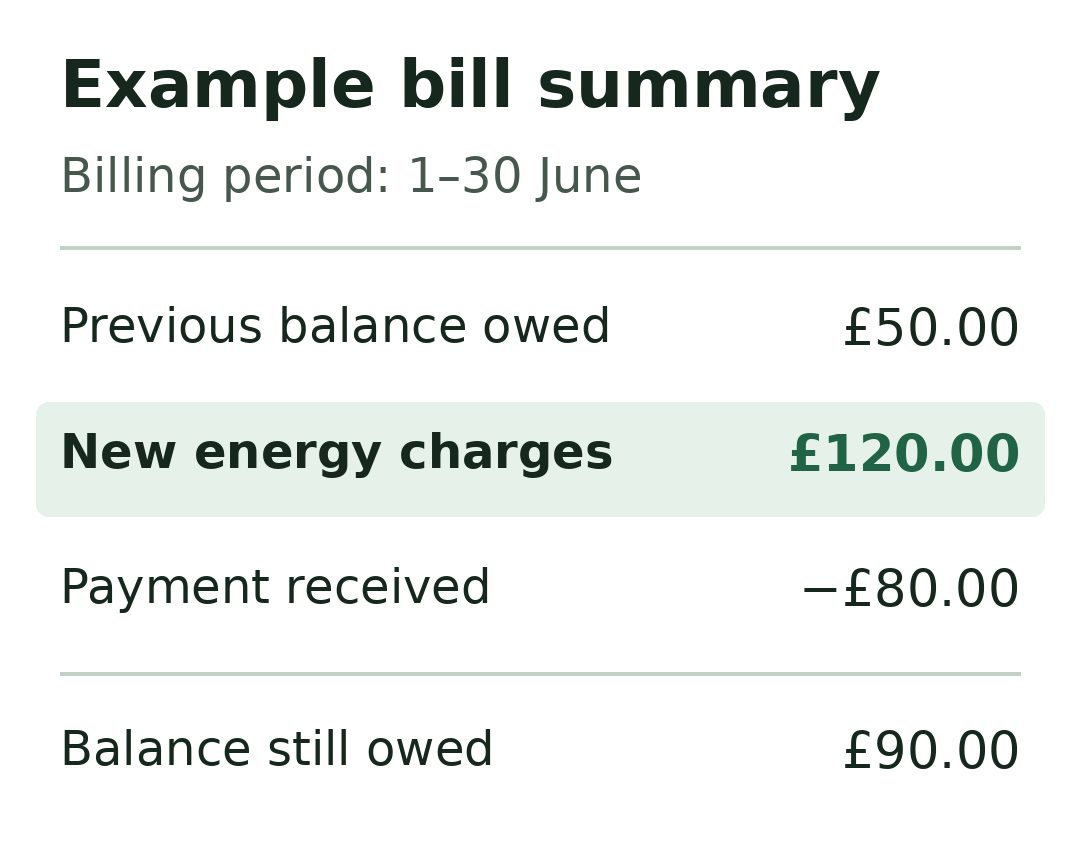
A credit can reduce what you owe without changing the price on any of the energy lines. If a Direct Debit went up, ask the supplier for its expected yearly use and the amount of any old balance it included. If you’re looking at one particularly cold month, compare usage per day with the same season in a previous year before using the month as the basis for a full-year estimate.
- If you think you’ve been charged too much for your energy - Citizens Advice
Citizens Advice. Checking unexpectedly high charges, estimates and meter details. Accessed 25 November 2026. - If your energy supplier has increased your direct debit payments - Citizens Advice
Citizens Advice. Estimated energy use, payments and existing amounts owed. Accessed 25 November 2026.
Know what to ask your supplier
If the latest reading is estimated, compare it with the meter today. A reading lower than the estimate is worth reporting, with the date it was taken. If the meter readings look wrong, take a dated reading and check the serial number, especially if your meter is in a shared cupboard. Compare it with both the number on your bill and the latest reading in your account. If it’s the standing charge or unit price you’re querying, give the supplier the exact bill dates and rate line, along with the Ofgem table you used.
Keep the original bill, your readings and the supplier’s reply. Ask for a corrected statement if a price or reading was wrong. If the bill is due soon or you’re worried about paying it, ask the supplier how it will handle your account during the check. If it can’t resolve the problem, follow the complaints guidance for where you live.
- If you think you’ve been charged too much for your energy - Citizens Advice
Citizens Advice. Checking unexpectedly high charges, estimates and meter details. Accessed 25 November 2026. - How to read your gas or electricity meter - Citizens Advice
Citizens Advice. Taking readings and telling actual and estimated readings apart. Accessed 25 November 2026. - Complain about your energy supplier or network operator | Ofgem
Ofgem. How to complain about a billing issue. Accessed 25 November 2026.
Sources and further reading
- Energy price cap and standing charges explained | Ofgem
Ofgem. Who the price cap protects and what it covers. Accessed 25 November 2026. - Energy price cap unit rates and standing charges | Ofgem
Ofgem. Current and upcoming rates, payment basis and postcode lookup. Accessed 25 November 2026. - If you think you’ve been charged too much for your energy - Citizens Advice
Citizens Advice. Checking unexpectedly high charges and meter registration. Accessed 25 November 2026. - If your energy supplier has increased your direct debit payments - Citizens Advice
Citizens Advice. How suppliers calculate payments and what to ask for. Accessed 25 November 2026. - Energy price cap and standing charges explained | Ofgem
Ofgem. Coverage, calculation and the benchmark annual bill. Accessed 25 November 2026. - Energy price cap unit rates and standing charges | Ofgem
Ofgem. Applicable period, regional tables, meter type and payment method. Accessed 25 November 2026. - If you think you’ve been charged too much for your energy - Citizens Advice
Citizens Advice. Checking unexpectedly high charges, estimates and meter details. Accessed 25 November 2026. - If your energy supplier has increased your direct debit payments - Citizens Advice
Citizens Advice. Estimated energy use, payments and existing amounts owed. Accessed 25 November 2026. - How to read your gas or electricity meter - Citizens Advice
Citizens Advice. Taking readings and telling actual and estimated readings apart. Accessed 25 November 2026. - Complain about your energy supplier or network operator | Ofgem
Ofgem. How to complain about a billing issue. Accessed 25 November 2026.
Related resources
- How the Ofgem energy price cap works
See which tariffs Ofgem’s energy price cap covers and understand unit rates, standing charges and the national headline figure.
- How to check whether your energy bill is correct
Check your energy bill against meter readings, rate dates, payment history and both fuel calculations before asking for a correction.
- What to do if your energy bill suddenly increases
Identify why an energy bill suddenly increased and gather the evidence you need to query it or arrange help with payment.
- Energy bill calculator
Estimate your combined gas and electricity bill using your meter usage, unit rates, standing charges and exact billing dates.
- Ofgem price cap calculator
Estimate costs under applicable Ofgem price-cap rates for your Great Britain region, payment method, meter and usage.
- How to reduce your energy bills in the UK
Check your tariff and use your meter to find the changes that could make the biggest difference to your UK household energy bills.
- What the latest energy price cap means for households
Find the current and next announced energy cap periods and see how a rate change could affect the household bill you actually pay.
- How to calculate your annual energy bill
Estimate annual electricity and gas costs from your usage and rates, with a worked example for both fuels and their standing charges.