Read a traditional electricity meter from left to right. How you deal with the last digit depends on whether you’re looking at a row of numbers or a set of little clock faces.
EnergyFigures editorial team · Published · Reviewed
If it has a row of digits
Copy the whole kWh. On a standard roller display, leave out the red fractional digits. For example, if the main black figures are 04736 and a separate red wheel shows 8, your whole-unit reading is 4,736. On a two-rate meter, copy both rows with their labels. You don’t need to add them to send them to the supplier.
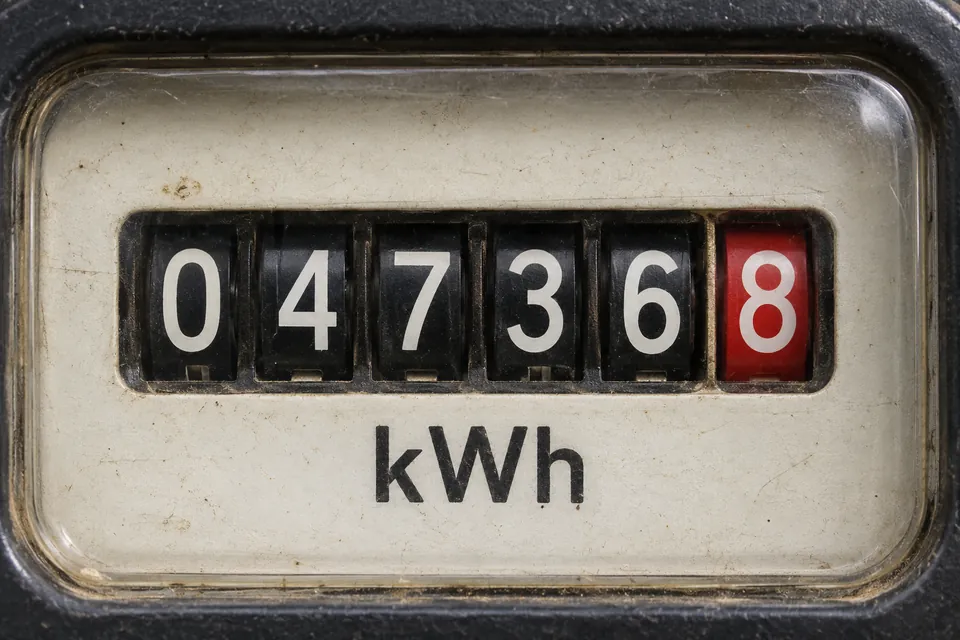
- How to read your gas or electricity meter - Citizens Advice
Citizens Advice. Electricity dials, two rates, digital and gas registers. Accessed 25 November 2026.
If it has clock faces
The pointers can turn in opposite directions on neighbouring dials. Follow the printed numbers round each face. If a pointer is between two numbers, write the lower one. Between 9 and 0, write 9. Ignore a red dial or one marked as tenths.
Citizens Advice suggests underlining any number a pointer lands on exactly. Look at the next dial to its right. If that pointer is between 9 and 0, the underlined digit hasn’t quite turned over. Reduce it by one, wrapping 0 back to 9 if needed.
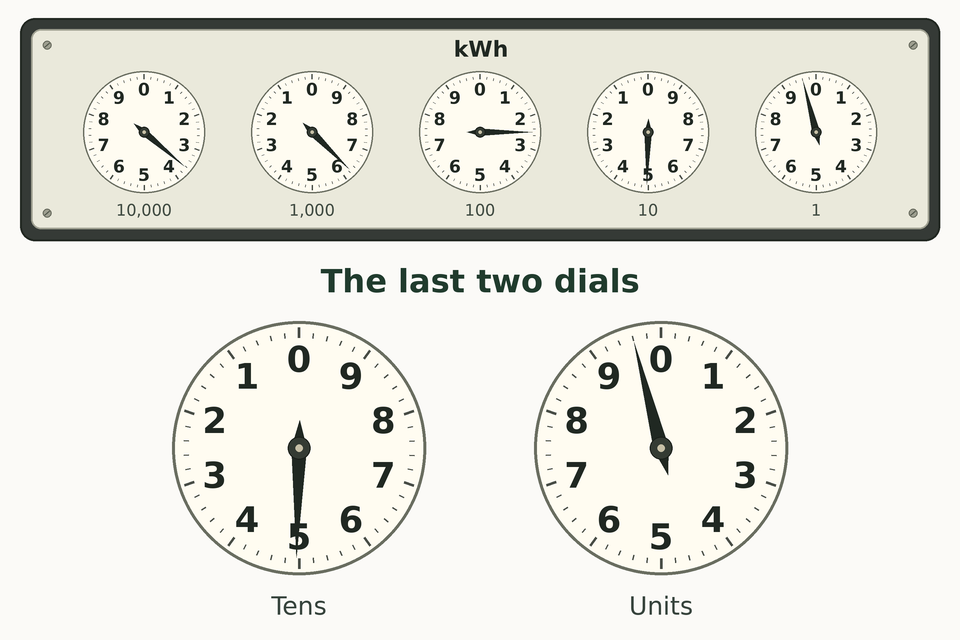
Take a straight-on photo and match the meter’s serial number to your bill, particularly in a shared cupboard. If the supplier queries a reading, that picture saves you trying to remember which way a dial was turning.
- How to read your gas or electricity meter - Citizens Advice
Citizens Advice. Electricity dials, two rates, digital and gas registers. Accessed 25 November 2026.
Sources and further reading
- How to read your gas or electricity meter - Citizens Advice
Citizens Advice. Electricity dials, two rates, digital and gas registers. Accessed 25 November 2026.
Related resources
- How to read a smart meter
Copy the right smart meter import register or gas volume reading, keep the register label and record what you submitted.
- How to read your electricity bill
Find the units, dates, meter readings and charges on a domestic electricity bill and distinguish them from your payments.
- Understanding Economy 7 electricity tariffs
Understand Economy 7 electricity rates and compare them with a single-rate tariff using your day and night readings.
- How smart meters work
Follow a kettle boil from electricity meter to display to supplier, and see which connections depend on home broadband.
- How to read a gas meter
Copy a gas meter’s whole reading, distinguish cubic metres from imperial units and keep old and new meters separate.
- How to understand your smart meter in-home display
Use a kettle boil to read current demand, daily energy and estimated spending on your smart meter display.